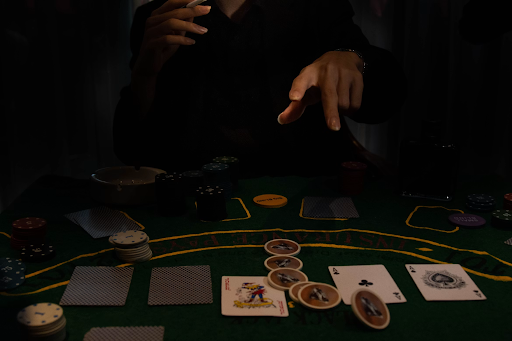
Risk is one of the oldest engines in storytelling. Long before cameras existed, the question of what a person might lose – and what they might gain – drove audiences to lean forward. Cinema discovered early that risk doesn’t need to be physical to be gripping. A character sitting across a table from an opponent, holding cards or watching a roulette wheel, can carry more tension than any chase sequence if the filmmaker knows what they’re doing.
What makes gambling such a durable cinematic subject isn’t the mechanics of the games themselves. It’s the psychological pressure those mechanics create – the forced confrontation with uncertainty, the moment where everything hinges on a single decision or a single card. Environments built around that pressure have always fascinated directors because they compress the human drama of risk into a physical space. Online platforms like slimking carry the same tension into a digital register – the stakes are real, the uncertainty is real, and the storytelling potential travels with them.
Why Risk Makes Characters Revealing
The simplest reason gambling scenes work in film is that they strip characters down. In ordinary life, people manage how they present themselves. Under genuine pressure – when real money, real pride, or real safety is on the line – that management breaks down.
The Stress Test Principle
In The Cincinnati Kid, Steve McQueen plays a poker prodigy whose entire identity rests on being the best. The film’s climactic hand doesn’t just determine whether he wins money. It determines whether the story he’s been telling about himself is true. The gambling is the stress test. Character is what cracks or holds under it. This dynamic works in comedy as well as drama. Something has to genuinely matter for the scene to hold an audience’s attention. The risk has to carry weight – emotional first, financial second. Remove the genuine stakes and the cards become props. Keep them real and every hand becomes a small revelation.
The Three Modes of Screen Gambling
Films approach gambling in distinct ways depending on what they’re really about.
| Mode | What It Explores | Examples |
| The Skill Game | Mastery, reading people, controlled deception | Rounders, Casino Royale |
| The Addiction | Loss of control, self-destruction, compulsion | The Gambler (1974), Hard Eight |
| The Heist | System-beating, collective intelligence, planning | Ocean’s Eleven, 21 |
| The Metaphor | Life as gamble, fate, philosophical risk | Deer Hunter, No Country for Old Men |
Each mode creates a different kind of suspense. The skill game generates tension through reading: can the hero read the opponent before the opponent reads them? The addiction film generates dread through inevitability. The heist generates pleasure through competence – watching smart people execute a complex plan against a powerful system.
What the Addiction Mode Gets Right
Films built around gambling compulsion work differently. They’re less interested in the game than in the psychology underneath it. The Gambler, based on Dostoyevsky’s semi-autobiographical novel, understands that compulsive gambling isn’t really about money. It’s about the longing for a definitive moment – the wish to have destiny resolve something ordinary life consistently leaves undecided. That insight makes the film uncomfortable in a way a pure thriller doesn’t. The audience can’t root for the character to win, because winning doesn’t fix the problem. The only resolution available is the one the character most fears.
Luck as Dramatic Device
Luck is philosophically interesting in ways that pure skill isn’t. When a character succeeds through luck, it raises questions about fairness and what the universe actually rewards. When a character fails despite doing everything right, it raises harder questions still – about effort, merit, and the randomness that sits underneath every outcome.
When the Cards Don’t Care
Some of cinema’s most memorable gambling scenes are ones where the protagonist loses not through any failure of nerve but simply because the cards fell wrong. Films willing to let characters lose on those terms tend to be the more honest ones. The Cincinnati Kid ends with McQueen’s character making the statistically correct play and losing anyway. The older champion draws an inside straight that should never have appeared. McQueen’s face in that final moment – the inventory of everything he built, quietly dismantled – is one of the more honest depictions of what luck actually feels like when it runs against you.
Why the Subject Keeps Returning
Cinema returns to gambling not because directors are fascinated by card games but because the card table concentrates everything that makes human drama dramatic. Desire, fear, self-deception, the limits of skill against chance – all of it compressed into a few square feet and a handful of minutes. The camera has nowhere else to look. Neither does the audience. That’s the deal gambling has always struck with storytellers, and it keeps paying out.