The Engineering Conflict: Luminous Efficacy vs. Visual Comfort
In the development of indoor commercial luminaires—spanning office workspaces, educational facilities, and large-scale retail environments—structural and optical engineers face a persistent conflict: maximizing luminous efficacy (lm/W) while strictly controlling visual glare.
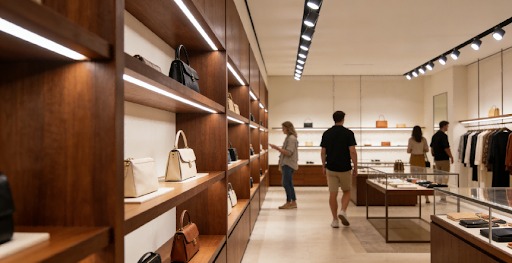
European standards, such as EN 12464-1, dictate stringent Unified Glare Rating (UGR) limits to ensure occupant comfort and prevent eye fatigue. For tasks requiring continuous reading and writing in offices, the requirement is strictly UGR < 19. Similarly, high-end retail and grocery environments increasingly demand UGR < 19 or UGR < 22 to ensure shoppers can comfortably view shelving without experiencing direct light source irritation.
The standard engineering approach to increasing a luminaire’s efficacy is to utilize higher-efficiency LED packages or highly transmissive flat covers. However, without precise secondary optical control, pushing more lumens through a standard diffuser inevitably increases the surface luminance at high viewing angles, causing the fixture to fail glare simulations in software like DIALux.
The Physics of High-Angle Light and UGR Calculation
To solve the glare problem, it is necessary to examine the physical mechanics of the UGR calculation. The UGR value is not a measure of a luminaire’s absolute brightness. Instead, it is a calculated ratio that depends on the background luminance of the room, the solid angle of the luminaire’s luminous parts as seen by the observer, and the luminance of the luminaire in the specific direction of the observer’s eye.
The critical vector for direct glare in most architectural spaces occurs at viewing angles above 65° from the vertical axis (nadir). When a luminaire emits a high concentration of luminous flux in the 65° to 90° zone, it intersects directly with the natural line of sight of the occupants. Minimizing the candela output in this specific angular zone is the fundamental optical requirement for glare reduction. For practical applications of how these photometric principles are applied to specific commercial environments to maintain strict glare limits, engineers often reference specialized documentation, such as The Ultimate Guide to Retail Grocery Store Lights, which breaks down the necessity of achieving UGR < 19 in detail.
The Photometric Deficit of Opal Diffusers
Historically, the industry relied on extruded PC or PMMA opal diffusers to hide LED pixelation. These diffusers operate via volumetric scattering, utilizing internal particulate additives to bounce light in random directions until it exits the plastic.
The resulting photometric distribution is fundamentally a Lambertian profile. In a Lambertian distribution, the luminous intensity follows the cosine of the emission angle, typically resulting in a wide, unguided 120° beam spread. From an engineering standpoint, this is highly inefficient for glare control. Because the light is scattered passively rather than directed actively, a massive percentage of the lumen output is pushed laterally into the critical 65° to 90° glare zone.
This passive scattering creates a dual problem. First, it pushes the UGR value well above acceptable limits, causing visual discomfort. Second, it wastes usable photons. Light that is emitted horizontally does little to contribute to the target illuminance on the horizontal working plane (desks) or the vertical display planes (retail shelving).
The Physics of Micro-Prismatic Refraction
To achieve strict optical cutoff and suppress high-angle glare, the optical system must shift from passive volumetric scattering to active refraction. This is accomplished through the use of precision injection-molded linear lenses engineered with micro-prismatic surface geometries.
Unlike standard flat diffusers, a micro-prismatic lens features an array of precisely calculated three-dimensional structures—often conical, pyramidal, or complex asymmetrical ridges—embossed into the optical polymer. These structures operate on the principles of Snell’s Law of Refraction. As the uncollimated light rays emitted from the LED package exit the high-density polymer (PC or PMMA) and interface with the lower-density air, the angled facets of the micro-prisms bend the light path.
Through rigorous optical simulation during the mold design phase, engineers calculate the exact angles of these micro-structures to intercept light rays that would naturally exit the fixture at 70°, 80°, or 90°. The lens systematically refracts, or “folds,” these high-angle rays downward, redirecting them into the 0° to 60° central cone. This optical redirection serves two simultaneous engineering functions: it sharply reduces the candela output in the glare zone—dropping the UGR value well below 19—while significantly increasing the lux levels delivered to the horizontal task plane.
Modular Engineering and the Zhaga Consortium
While custom optical profiling is sometimes necessary, designing proprietary injection molds for every linear luminaire is highly inefficient from a manufacturing and supply chain perspective. To scale production and simplify luminaire assembly, structural engineers heavily rely on standardized dimensional footprints.
This standardization is largely driven by the Zhaga Consortium, an industry organization that defines the mechanical, electrical, and thermal interfaces of LED components. By adhering to Zhaga specifications, luminaire manufacturers ensure that LED boards and secondary optics from different suppliers are fully interoperable. For linear indoor lighting, this modularity is critical for managing inventory and accelerating product time-to-market.
Implementing the 280x40mm Standard Form Factor
Within linear office and retail lighting, one of the most widely adopted mechanical formats is the 280x40mm Zhaga Standard linear lens module. This specific dimensional footprint (280mm in length and 40mm in width) aligns perfectly with industry-standard linear LED light engines.
Specifying this standardized linear lens provides significant mechanical and operational advantages for luminaire manufacturers:
Mechanical Integration: The 280x40mm modules are engineered with standardized mounting pitches and integrated snap-fit mechanisms. This allows the lens to lock directly onto the LED board or the aluminum extrusion without the need for secondary adhesives or complex mechanical fasteners, eliminating assembly tolerances that cause light leakage.
Photometric Versatility: The primary advantage of the standardized footprint is optical interchangeability. A manufacturer can design a single linear aluminum trunking system and offer it for vastly different applications simply by swapping the lens module on the assembly line. Utilizing the exact same housing, engineers can install a 90° lens for general ambient lighting, a narrow 60° micro-prismatic lens for UGR < 19 compliant office desks, or a double-asymmetric lens for illuminating vertical retail shelving.
Conclusion: System-Level Validation via Photometric Data
In the specification and procurement of commercial lighting, visual comfort is not treated as a subjective aesthetic; it is a measurable engineering parameter mathematically verified through standardized photometric files (IES or LDT).
When a luminaire manufacturer attempts to use basic diffusers to hit UGR targets, the resulting photometric distribution often fails to meet the strict cutoff criteria during DIALux or Relux software simulations. By integrating precision micro-prismatic linear lenses—specifically those utilizing reliable, standardized mechanical footprints—engineers guarantee that the luminaire will perform exactly as simulated. This active photon management ensures the system delivers high luminous efficacy to the working plane while strictly maintaining the required UGR < 19 threshold, ultimately securing project compliance and long-term visual comfort for end-users.